
General Objectives:
Techniques and technologies will be investigated and developed, mostly based on the theoretical and practical foundations that reside at the intersection of Systems Engineering and Automation, Computer Science and Artificial Intelligence, and Intelligent Manufacturing Engineering, to advance the state of science and technology in:
(i) monitoring systems (at the machine/device level) using digital twins and quality control (plant level) both based on machine learning aimed at manufacturing machines/devices and the production process, supported by supervised learning strategies and data integration and fusion.
(ii) strategies for intelligent recommendations (machine and plant level) through knowledge generators and supported by new data augmentation methods.
(iii) self-learning methods for monitoring the lifespan of machinery (at the machine level) and quality control (at the plant level), as well as data-based intelligent recommendations (proactive actions) through human-centered decision-making (data-driven knowledge transfer from/to people).
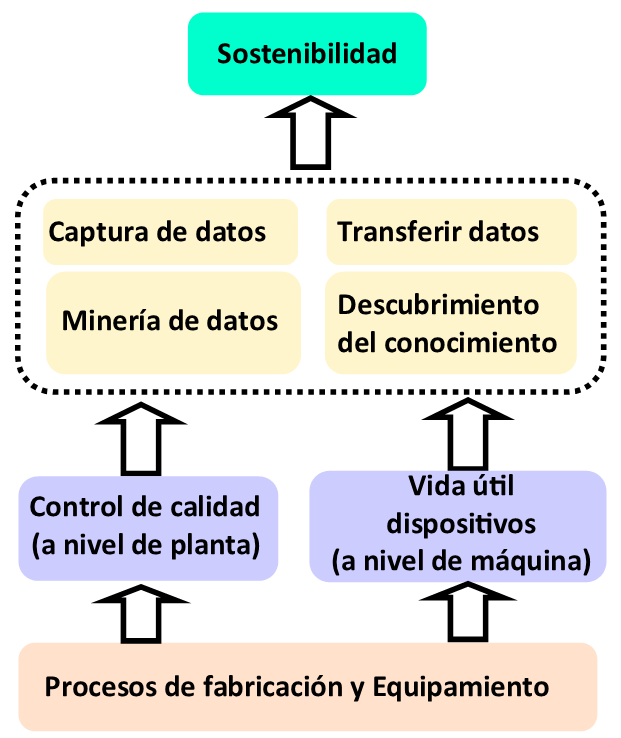
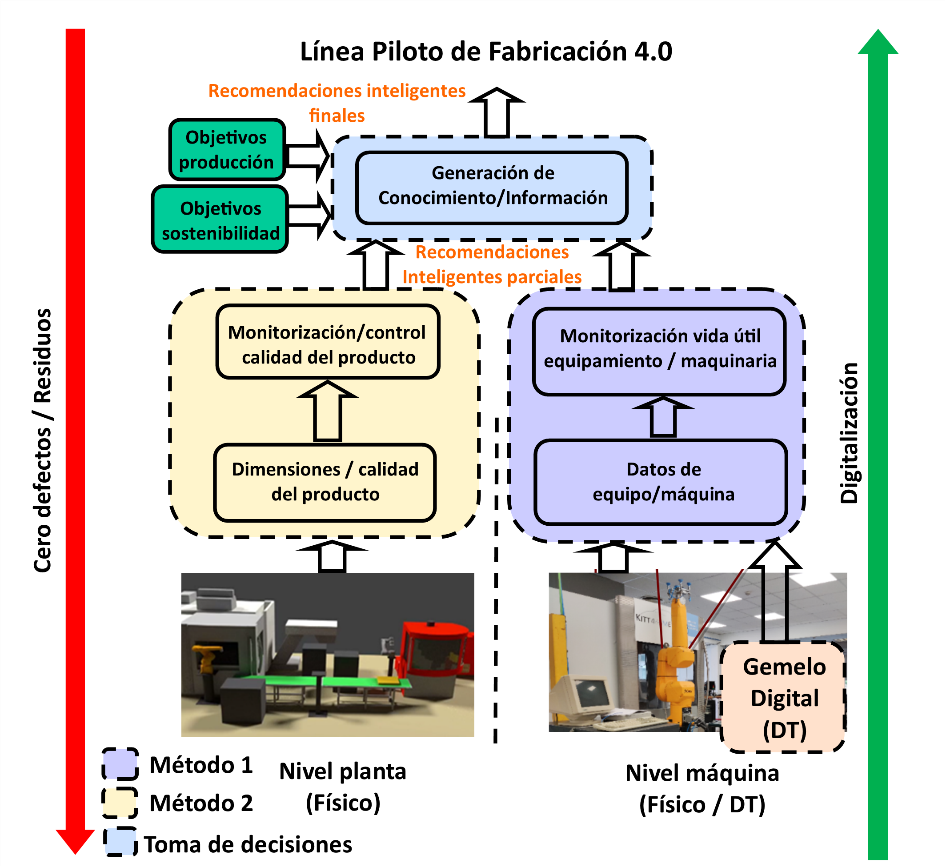
The general scientific-technical objective of the project is the design and development of two self-learning methods and their validation in an Industry 4.0 pilot line: one for monitoring the lifespan of machinery/manufacturing devices (machine level) based on digital twins and another for product quality control (plant level). Additionally, the output will include corresponding intelligent recommendations and human-centered decision-making (machine and plant level) to maximize the sustainability of the manufacturing process.
The aim is to address some of the most urgent problems in the manufacturing industry, such as sustainability, an indispensable requirement in the new ecological transition, which is facilitated by the new digital tools available in the industry of the future. On the one hand, at the machine level, this sustainability is achievable by increasing the lifespan of manufacturing machinery and devices through state monitoring and fault prediction. On the other hand, at the plant level, this sustainable approach is obtained through zero-defect manufacturing, and more specifically, zero waste through a quality control system for the manufacturing process of the product. In both approaches, final decisions are made towards the human operator based on partial intelligent recommendations and new artificial knowledge generated from data. Additionally, productivity is improved by reducing downtime, enabling more effective maintenance, and placing operators and technologists at the center of the digital transformation towards an ecological transition. Key performance indicators will be identified and evaluated, after their proper integration, on the Industry 4.0 demonstrator, considering an increasing level of technological maturity (TRL). For example, knowledge/recommendation generator (TRL5) and self-learning methods (TRL 6) applied to an Industry 4.0 pilot line.
Specific Objectives:
To achieve the general objective of the project, the following specific objectives are defined:
O1. Design and develop a monitoring method based on machine learning strategies to determine the lifespan and predict faults in manufacturing machinery/devices.
O2. Design and develop a quality control method based on AI and vision to monitor the product’s status at each production stage along the pilot manufacturing line.
O3. Design and develop a strategy for generating new data-based knowledge aimed at improving the quality of process information.
O4. Design and develop a transparent and explainable decision-making method to evaluate the final outcome of the recommendations carried out by human operators.
O5. Implement and evaluate the proposed methods in O1, O2, O3, and O4.
O6. Integrate and evaluate the developed methods in an Industry 4.0 pilot line.
These objectives are achievable within 2 years, considering that the working team is expert in the subject, some previous results are available, and the number of researchers (3 research team and 3 working team) is aligned with the number of proposed objectives.
Period of the project: 2021-2025
Supported by iGENZERO project with reference TED2021-131921A-I00, funded by MICIU/AEI/10.13039/501100011033 and by the European Union NextGenerationEU/PRTR.
