
GAMHE
Pilot line of Industry and Society 5.0
The industrial sector faces a major challenge in establishing safe and efficient human-robot interactions due to the growing digitalization and automation in manufacturing processes. Digital twins, among the modeling tools currently used, play a fundamental role in optimizing and predicting results. Projects such as FORTIS, framed within the concepts of Industry 5.0, propose the implementation of collaborative production lines where a safe interaction between humans and robots is guaranteed. This is achieved through the use of models and simulations of these interactions. In order to achieve the best performance in a production line, it is necessary to monitor all the components, including human operators. This involves recognizing and assessing parameters to create optimization models. These models can predict the line’s behavior and assist in decision-making.In this project, we analyze a case study of an experimental pilot line. The main objective is to design, develop, and evaluate digital twins that can model the behavior of operators, robots, and their interactions. Lastly, we will present future work and projections corresponding to this project.
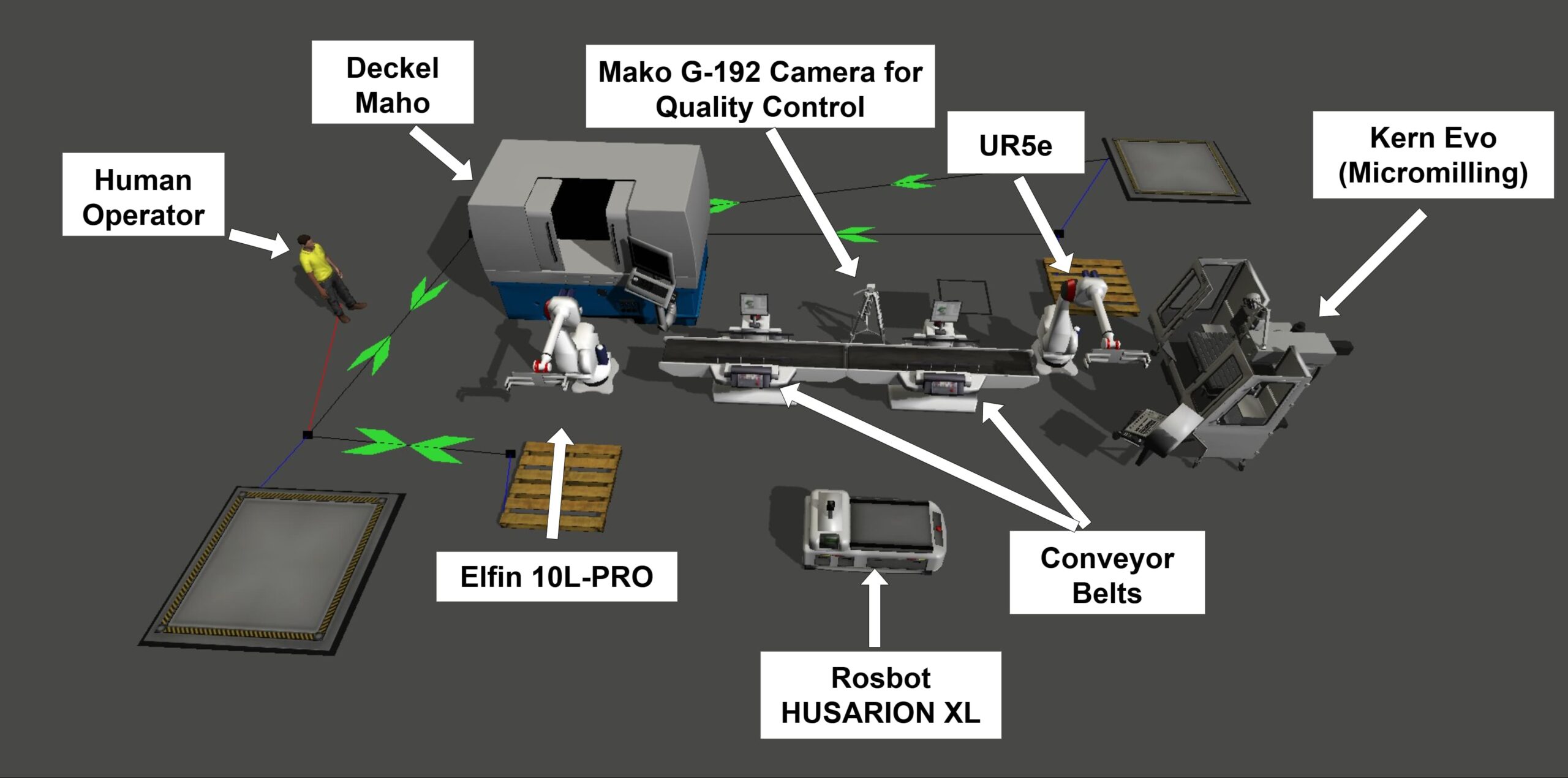
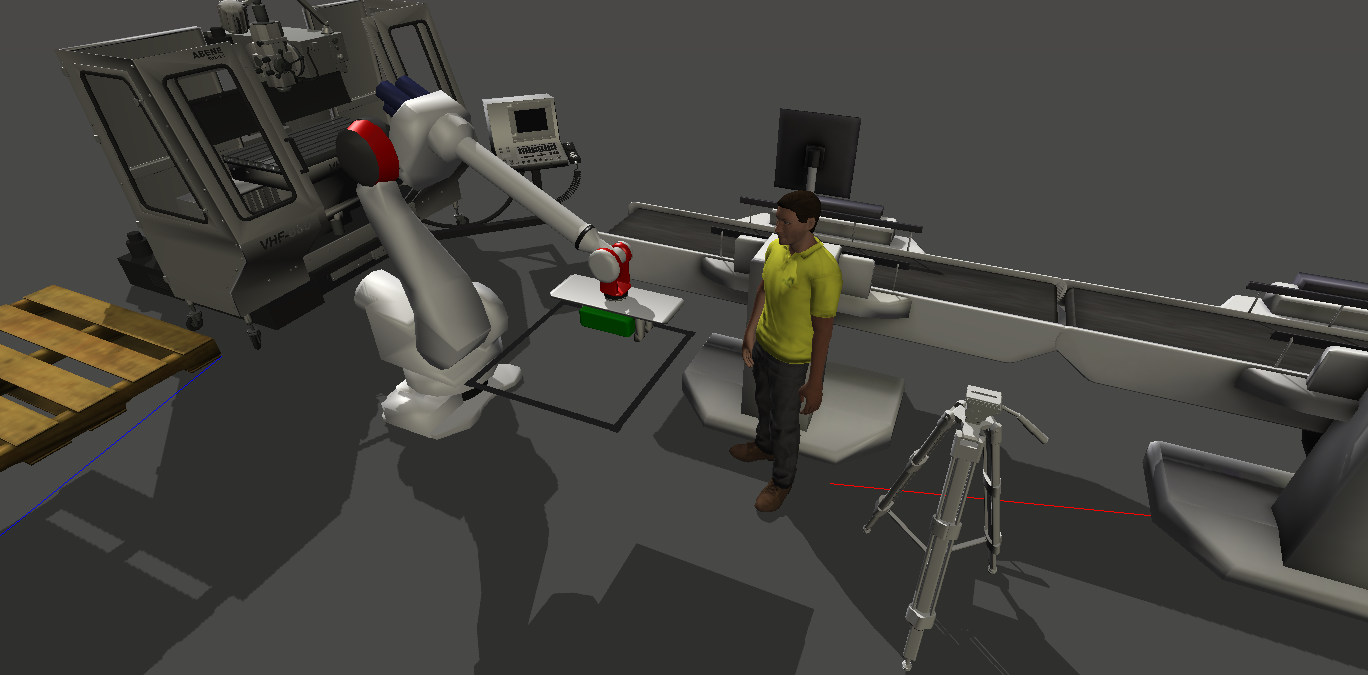
The pilot line implemented in this research is a micro-manufacturing line designed to produce parts for various applications. It includes:
- Machining Center (Deckel): Machinning center for the first step in the manufacturing process
- Machining Center (Kern EVO): An ultra-precision micromachining center with a laser control system for the details in the produced workpieces.
- Robot Manipulator (Elfin 10L-PRO): Robotic arm that start the manufacturing process
- Robot Manipulator (UR5): Manipulator robot for handling workpieces.
- Conveyor Belts: Two conveyor belts for transporting workpieces.
- Autonomous Mobile Robot (ROSbot XL HUSARION): A robot equipped with LiDAR and a camera for transporting manufactured parts.
- Quality Control System: An Allied Vision Mako G-192 camera for quality control.
- Human Operator: In charge of the interactions with the system, performing tasks like quality control and operating the machine tool.
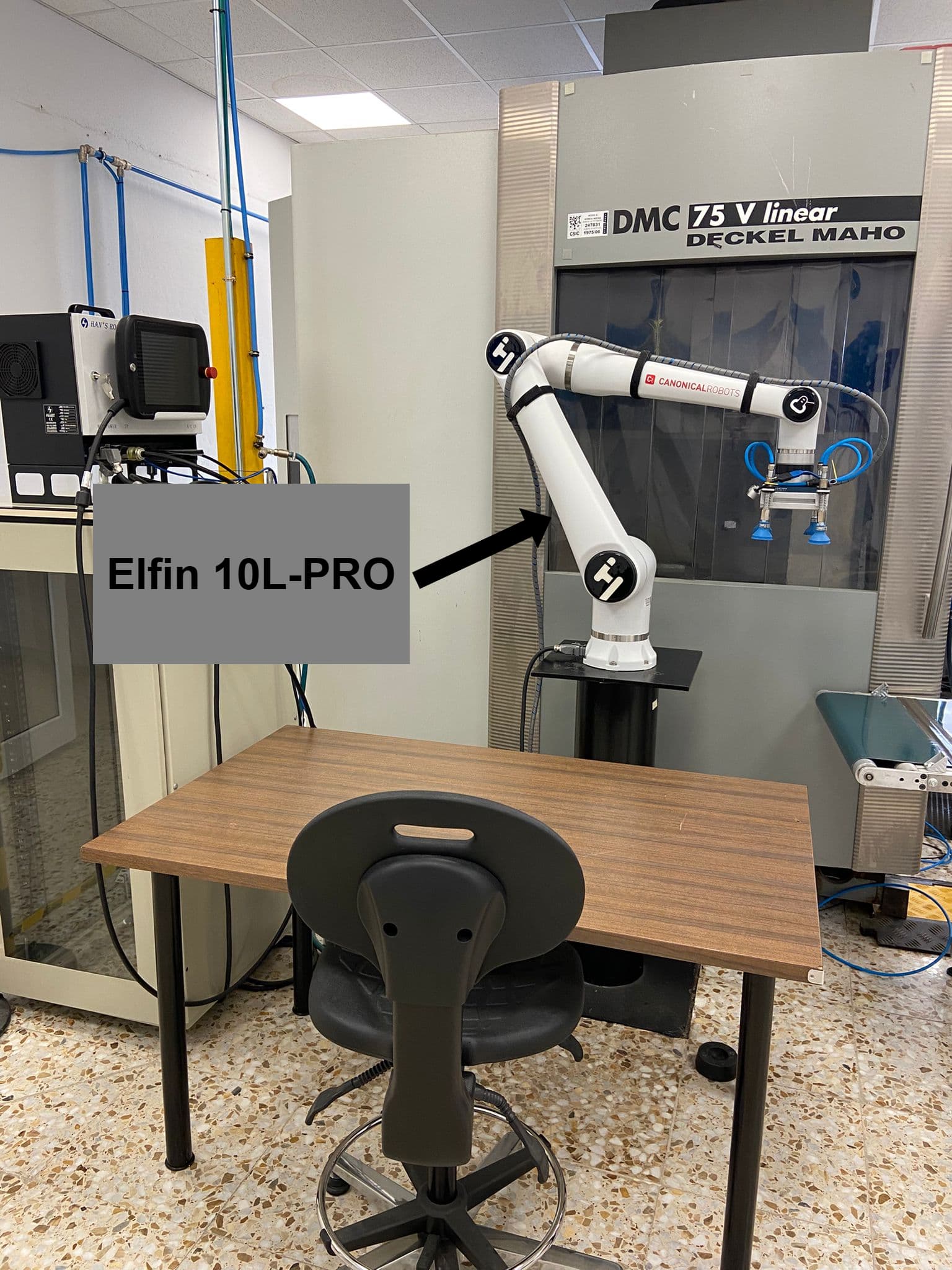
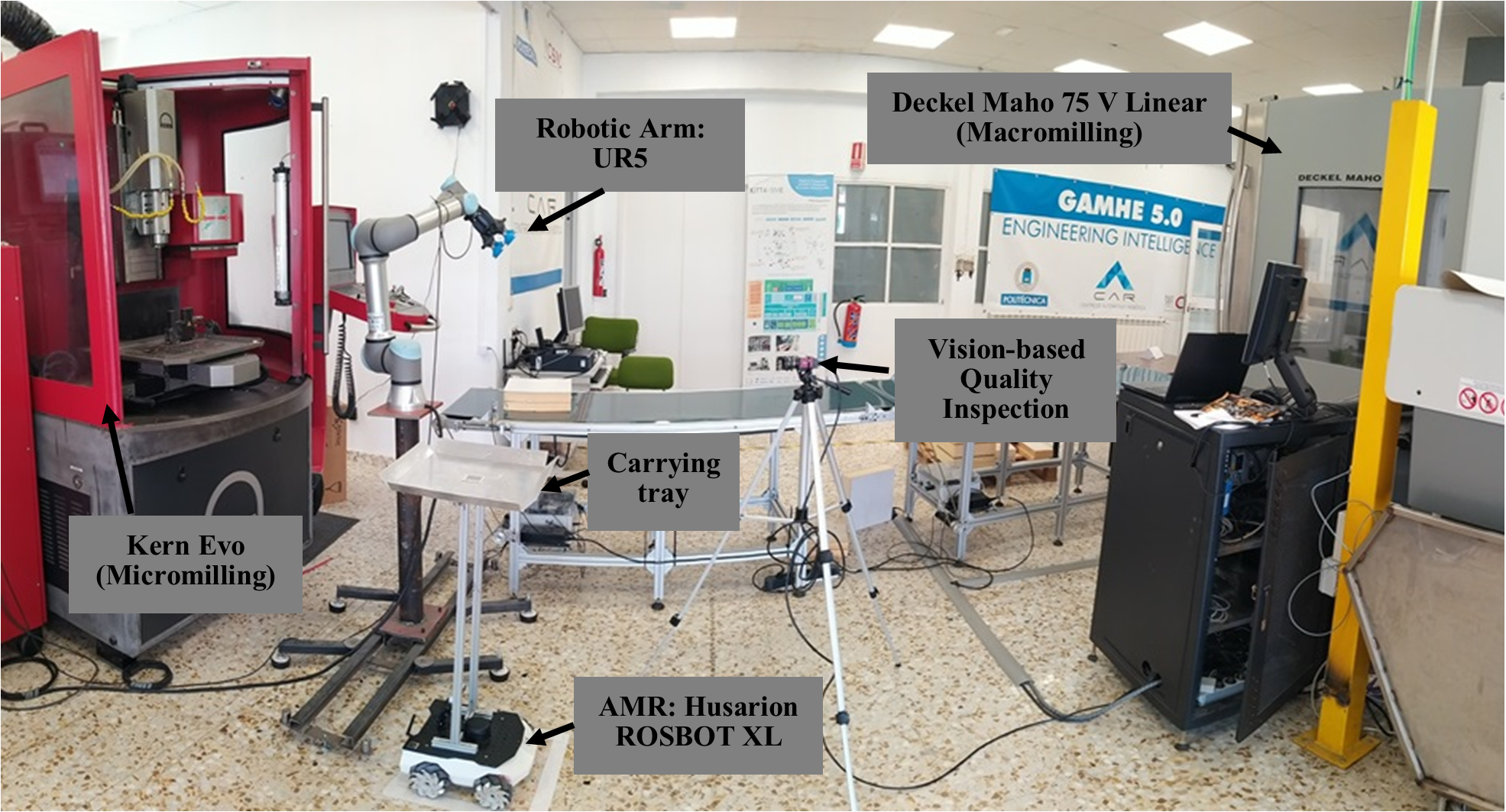
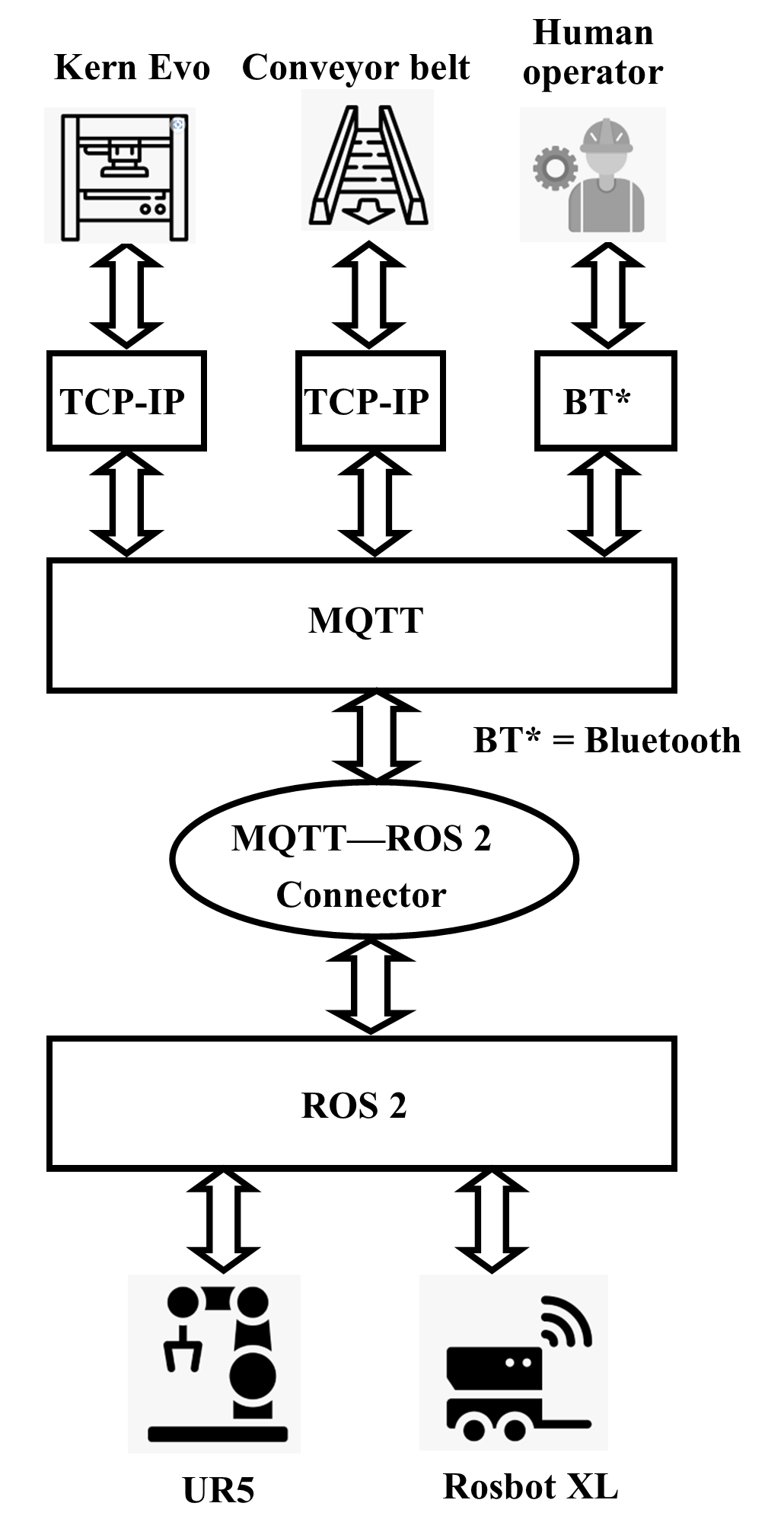
The communication system in the pilot line is designed to facilitate seamless data exchange between all components:
- TCP/IP via Ethernet: Used for communication between IoT nodes and machine tools.
- ROS 2: Used for communication between the UR5 robot and the ROSbot XL.
- MQTT: Used for communication between IoT nodes and wearable devices.
- Wear OS: Used for communication between wearable devices and the IoT nodes.
The purpose of the Digital Twins in this research is to create a virtual representation of a collaborative Industry 5.0 pilot line, focusing on human-robot interaction. This digital model aims to simulate the behavior of both human operators and robots in real time, allowing researchers to analyze and optimize resource allocation, predict system performance, and improve the efficiency of the production line. By incorporating real-time data from sensors and wearable devices, the Digital Twin provides a platform for testing different interaction scenarios, evaluating the impact of human factors, and ultimately enhancing the safety and effectiveness of human-robot collaboration in manufacturing.
Watch an explanatory video of the pilot line from our YouTube channel: